
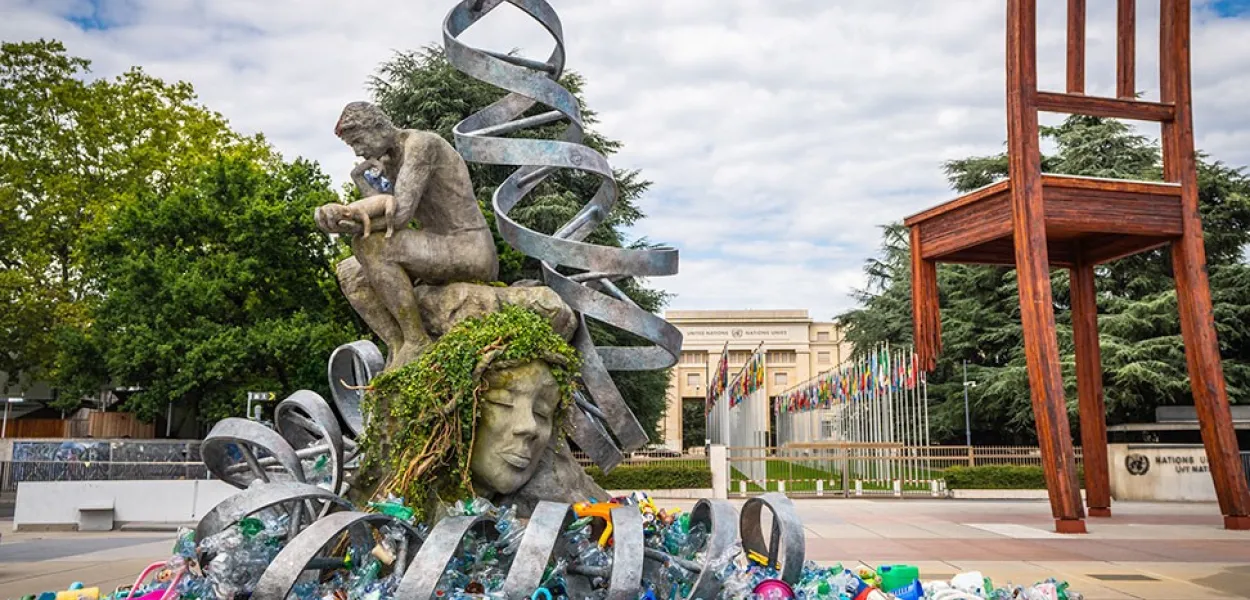
For nearly two weeks, a six-metre-tall sculpture has dominated the plaza in front of Palais des Nations in Geneva, Switzerland. The installation depicted a version of Auguste Rodin’s The Thinker sculpture, holding plastic bottles and an infant. The Thinker rests on a depiction of Mother Earth. Next to this, rises the double helix strand of DNA. All of this is surrounded by a sea of plastic — bottles, bags, fishing nets and containers.
And all of it is a message, said Benjamin Von Wong, the artist who created the installation.
“The whole plastics problem is kind of growing every day,” Von Wong said, as he adjusted another bottle, adding to the installation. “We are adding more pieces of plastic to this sculpture to really highlight the rising cost of inaction. To show these treaty negotiations the price of inaction. The time is now for us to make a difference. The time is now for us to do something about it.”
The Thinker’s Burden was installed during the second part of the fifth session of the Intergovernmental Negotiating Committee (INC) to develop an “international legally binding instrument on plastic pollution, including the marine environment.” The negotiations took place for nearly two weeks in Geneva in early August, with an aim to developing a treaty dealing with the full lifecycle of plastic pollution globally, said Benjamin Schacter, Senior Human Rights Officer at UN Human Rights.
“UN Human Rights has been actively engaged with the negotiations since the beginning, organizing events, providing technical advice and support, convening partners and making submissions and statements,” he said. “The hoped for outcome is an ambitious treaty that addresses the full lifecycle of plastics and that will ensure a human rights-based approach to rapidly and equitably end plastic pollution.”
However, the hoped for treaty did not occur. Negotiators failed to reach an agreement on a plastics treaty, paving the way for another round of negotiations. UN Human Rights Chief Volker Türk called the failure “terrible news.”
“We stand with all who are paying the price for the greed of plastics producers,” he wrote on his X account. “People have a right not to be contaminated and not to have their waterways choked by plastic.”
People behind the fight against plastic pollution
“Our planetary systems cannot tolerate the volumes, masses and complexity of plastics, materials, products, chemicals that we’re making today,” said Bethanie Carney Almroth, professor of ecotoxicology at the University of Gothenburg in Sweden. “We know that (plastics) quite literally are destabilizing the Earth system, affecting climate, affecting biodiversity, affecting nutrient cycling. And the more we learn, the more the evidence is growing stronger.”
Carney Almroth coordinates a coalition of more than 400 scientists from across 65 countries who provide evidence-based information on plastics pollution, which is made available during the negotiations. Access to such information is crucial for the negotiations.
“The work we’ve done bringing science here, along with other scientists who are active in this space, has really been instrumental in help us not just understand the impacts of plastic pollution, but also indicate where we need solutions. We might be able to find something that is truly effective if we follow the evidence,” she said.

Bethanie Carney Almroth is a professor of ecotoxicology at the University of Gothenburg in Sweden. She also co-coordinates a coalition of more than 400 scientists from across 65 countries who provide evidence-based information on plastic pollution. © Bethanie Carney Almroth
Access to information needs to be two-way, with negotiators being made aware of how plastic pollution affects communities at a grassroots level, said Griffins Ochieng, from the Centre for Environment Justice and Development (CEJAD). The Kenya-based CSO promotes sound management of chemicals and waste to protect human health and environment. Hazardous chemicals in plastics leach into the environment, infringing on human rights, he said.
“We have to recognize that people are at the centre of the negative impact of plastic pollution,” Ochieng said. “These are populations or people, such as waste pickers, that are directly or indirectly exposed…and whose livelihood and health are (directly) tied to plastics. The right to a clean and healthy environment, the right to participation, the right to health…all these rights need to be integrated into all discussions and negotiations of a treaty.”
For Terese Teoh, a member of the Singapore Youth for Climate Action (SYCA), limiting plastic pollution comes from a place of personal experience. While attending school, she remembered learning about the harms that plastic pollution causes the environment and the big push for recycling. Yet, when she stepped outside the classroom, plastic products were everywhere — inside the school canteen, in shops, in packaging.
“There was just this nonchalance towards plastics,” she said. “This contradiction did not sit well with me. I could not understand why we are telling our children one thing but practicing another.”
As part of the SYCA, Teoh works on plastic pollution from a rights-based approach — seeing the impact of production plants, recycling and incinerator protocols, and microplastics impact human lives and rights.
“I think a lot of young people in Singapore join the plastics movement because they see it as so rampant in their society and they just want to do something about it,” she said. “So, the first thing I tell my volunteers is that plastic is not just about reducing and recycling. It is an environmental justice issue.”
Anti-plastic pollution people
“The community that I come from, we don’t actually know what plastic is because plastic is not part of our culture,” said Indu Tharu, a writer, activist and member of Tharu people of Nepal.
Tharu said her community does not produce plastics and are not familiar with how to handle them. Everything for daily use was made from natural resources, such as plants, fibres and clay. But as plastic has become more pervasive, Tharu said she has noticed new health issues arising among the Tharu community, including an increase in illnesses such as cancer in younger people.
“We had never heard of cancer in our community, but now, it’s become very common,” she said.
For Indigenous communities like hers, the fight against plastic pollution is fight for cultural rights.
The challenges posed by plastic pollution cut across issue lines and groups, said Marie Therese Merhej Seif from the Women’s Major Group. The group is a civil society platform within the UN Environment Programme (UNEP), that represents women’s organisations in UNEA processes. It advocates for gender equality and the inclusion of women’s perspectives in environmental decision making.
In Western Asia, the region that Seif covers, plastic pollution is more than an environmental issue, it is a direct threat to the lives of millions who have been displaced by conflict. She cited the example of the millions of Syrian refugees living in Lebanon in camps whose assistance materials come in plastic containers; plastic that eventually has to be eliminated. This is normally done via burning, and when plastic is burned, the chemicals released are harmful to health, she added.
“The treaty will be judged not just by how much plastic it ends, but how it protects the most vulnerable including women, kids, and youth who have lost homes, access to clean water, or health systems,” she said.“And there is no global health without addressing plastic toxicity on the life of women who carry the burden of both pollution and peace building.”
Back in the plaza, Von Wong directed a group of protestors to a space within the installation for photos and chants. He said he liked that the artwork found resonance among the public and protestors. He hoped it would prick the conscience of treaty negotiators, keeping what they are working on front of mind.
“I think that having these visual anchors, these monuments and these moments in time are just one way of calling for accountability in a way that is super accessible,” he said. “And I think what’s fun about art like this is that everyone can interact with it however they want.”